The following Copyright and GenAI guides provide a summary of how you can use different types of materials within both public, private and self-hosted AI systems:
- Copyright and GenAI: a guide for students
- Copyright and GenAI: a guide for researchers
- Copyright and GenAI: a guide for use in teaching
For more detailed information about appropriate use of GenAI at UTS, read on below.
Importance of copyright awareness
Using AI tools without understanding copyright and data-sharing risks can lead to unintended consequences.
Uploading or copying material in GenAI tools may infringe on the copyright of others. It is also important that personal or confidential material is not shared within AI systems that use inputs to train their systems.
Australian copyright law does not currently provide any copyright rules for using GenAI tools with copyrighted materials, making it difficult to ensure compliance. Therefore, you should carefully consider whether you have the right to use the material and the type of tool you are using.
Do you have the right to upload and share copyright material in GenAI tools?
Before uploading anything to AI tools, it’s important to ask yourself whether you have the necessary rights to use the material and if the AI tool is appropriate for this type of content.
Since Australian copyright law does not have any specific rules that give extra rights to use material with AI tools, we need to apply existing copyright requirements. This means you must have permission before uploading or using it in AI.
This permission could come from:
- a publisher's licence that allows for the use of AI
- specific exceptions that allow its use in certain circumstances, such as a reasonable portion under fair dealing
- written permission from the copyright owner
- the work being in the public domain (no copyright applies)
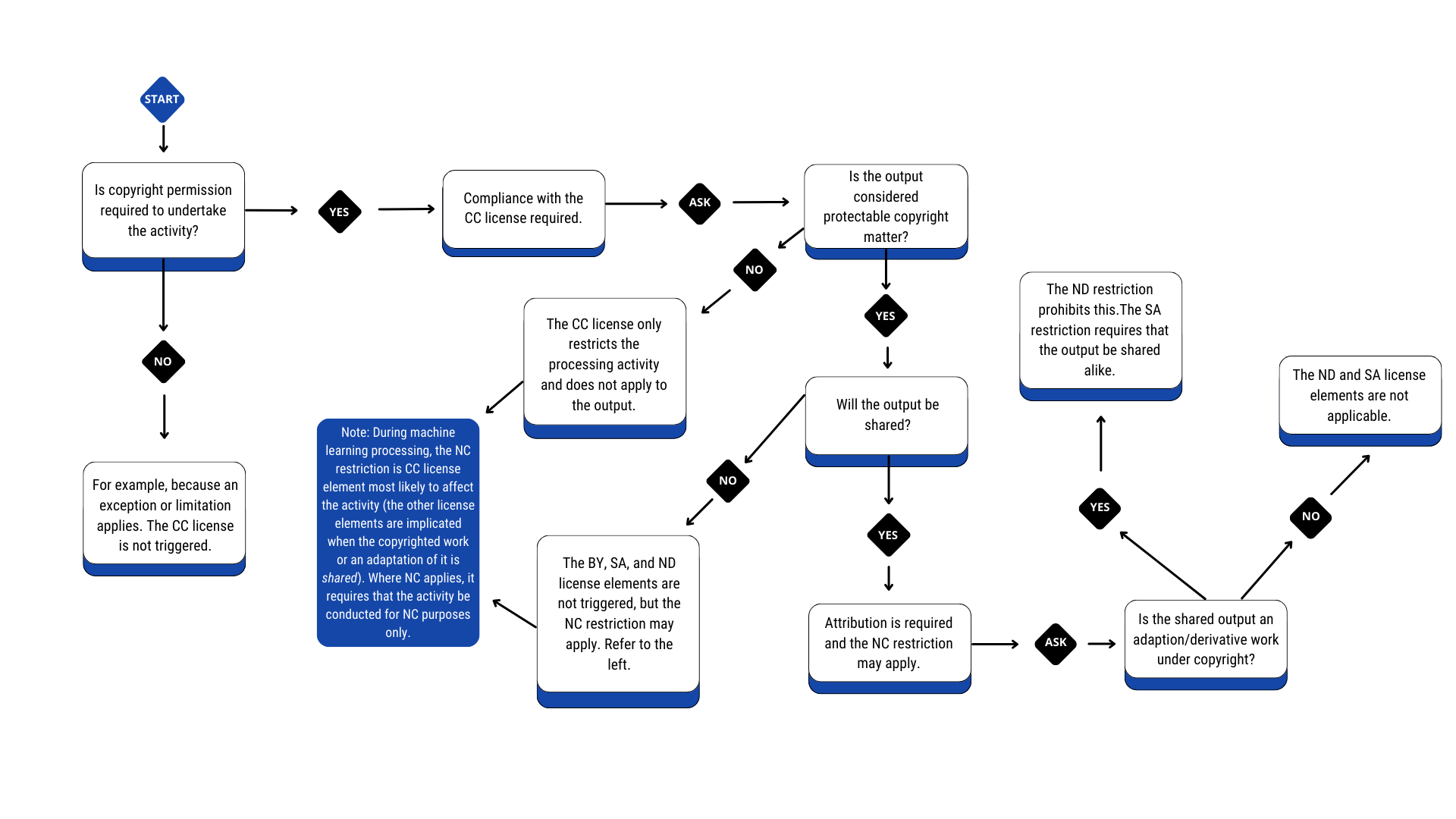
- the work having an open licence, such as Creative Commons (refer to the AI and CC flowchart for more information)
- the statutory licence (applies to teaching only)
Is the AI tool you are using appropriate?
The type of AI tool you're using also determines what you can safely upload. There are three main types of AI tools:
- Public GenAI tools such as free versions of ChatGPT, Gemini and Claude, are accessible and often free. These models tend to be trained on content that has been scraped or added by users.
- Private GenAI models, such as UTS’s enterprise version of Microsoft CoPilot, are those that run in a secure and protected environment, providing a safer option.
- Self-hosted AI tools – AI models or environments that researchers run on their own computing infrastructure or controlled environments. Examples: locally hosted open-source models, custom research environments for sensitive datasets.
Public GenAI tools, while accessible and often free, come with potential risks regarding data privacy and copyright infringement, as content you upload may be used to train the tool, making it available to other users. Some public AI tools allow users to opt out of AI training; however, this does not remove copyright, confidentiality, or data‑security risks associated with uploading material. At UTS, copyright material may only be uploaded on a case‑by‑case basis where a relevant copyright exception, licence, or permission applies. The University strongly encourages the use of approved, data‑secure tools such as Microsoft Copilot.
To find out which AI platforms use prompts to train their AI models, see the University of Newcastle Library factsheet.
Whether you are using public, private or self-hosted AI tools, you can upload and share the following:
- Public domain (no copyright) content
- Content that you created and own
- Open-licensed resources such as Creative Commons (refer to the AI and CC flowchart for more information)
- Materials for which you have copyright permission from the creator of the work.
However, if you use Private and Self-Hosted tools, where user data and/or inputs are not used to train AI systems, this increases your opportunities to use other materials under a current copyright exception and some licenced resources.
See the Copyright and GenAI guides for students, researchers or teaching to see how Private AI tools can be used.
Using Library resources and databases within public, private and self-hosted GenAI systems
Publisher-licensed digital resources available through UTS Library subscriptions, such as e-journals and e-books, should not be used within both public, private or self-hosted AI systems. To do so would breach the terms and conditions of the publisher's licences.
Alternatively, some publishers and vendors have integrated AI tools directly within their own platforms for use with their licenced content.
Using content generated by AI (Outputs)
Under current Australian Copyright law, copyright is only granted to original works expressed in material form by a human author demonstrating ‘independent intellectual effort’. For this reason, most works generated by AI will not be protected by copyright unless the work involves significant human intervention. If your generated output has significant human creativity added to the work, it’s a good idea to keep a record of your creative process.
If a work is generated by UTS staff and the generated work involves significant independent effort, then the output is owned by UTS.
Whilst there is no legislative requirement to provide attributions for AI-generated outputs, best practice is to acknowledge and/or reference the generated AI output.
Find out more about how to acknowledge and reference AI generated content.
Using AI generated outputs for teaching purposes
Outputs generated for teaching purposes may be covered under the educational statutory licence, but the following conditions must be met:
- Only to be used within private or self-hosted AI tools
- Only a reasonable amount can be copied (see Manage Your Content for limits)
- Not to be used outside of a teaching context
Using AI generated outputs for study and research purposes
Outputs generated for study and research purposes may be covered under the fair dealing provision as long as:
- only a ‘reasonable’ amount has been used (see Manage Your Content for limits)
- They are only to be used within private AI tools
- The output is not publicly shared, published or communicated to others
Publishing and AI
It’s also important to consider the use of AI when publishing your research. Authors should ensure that they are compliant with publisher expectations and have the necessary permission to reuse scholarly content in AI tools.
GenAI and Indigenous Cultural and Intellectual Property (ICIP)
The use of GenAI raises many issues, not only around copyright, but also Indigenous Cultural and Intellectual Property (ICIP). There are legal, ethical and cultural implications of AI’s interaction with Indigenous knowledge and art that can lead to misrepresentation, misappropriation, or inaccurate reproduction of Indigenous knowledge and cultural expression.
To learn more about these important challenges and their implications, read the blog post “The new frontier: Artificial Intelligence, copyright and Indigenous culture” by Emma Fitch, Clare McKenzie, Terri Janke, and Adam Shul
At UTS, the Use of AI in Research Guidelines provides guidance on ICIP considerations throughout the key research stages, such as project design and codesign and collecting, generating and analysing data.
UTS policies, procedures and guidelines
The following documents should be read in conjunction with this guide:
- Use of AI in Research Guidelines
- Artificial Intelligence Operations Policy and Procedure
- Academic Integrity Policy
- Research Policy and Research Management Procedure
- Research Data Management Procedure
Further reading
The links below provide further information and resources related to copyright and AI:
- Australian Copyright Council factsheet on Artificial Intelligence & Copyright
- Arts Law information sheet on Artificial Intelligence (AI) and Copyright
- Keep updated with the Government’s Copyright and Artificial Intelligence Reference Group (CAIRG) on issues related to AI and copyright.
Need help?
Contact Copyright Lead at copyright [at] uts.edu.au (copyright[at]uts[dot]edu[dot]au)
Note that this content is current as of April 2026 and may be subject to change.